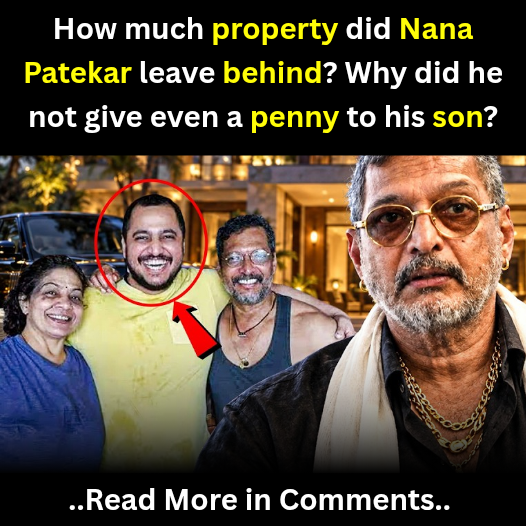
Nana Patekar:The Rebel Who Lived Like a Fakir on a Mountain of WealthDespite having immense wealth worth crores, why did Nana Patekar remain steadfast in spending his entire life in a modest 1-BHK flat in Mumbai? Did Manisha Koirala really catch Nana Patekar red-handed in an objectionable condition with Ayesha Jhulka in a locked hotel room? And was it just a strange coincidence that right on the morning of the 100th birth anniversary of his biggest rival, Raaj Kumar, Nana Patekar’s breath stopped forever at 5:20 AM?Friends, in this glittering world of Bollywood, there was one such face who never bowed down to any rules made by the industry. That ominous morning of October 8, 2026, shook the entire film industry to its core. At his peaceful seaside home in Goa, the man whose single voice could silence an entire cinema hall fell silent forever. A heart attack at the age of just 75 claimed the life of Indian cinema’s most outspoken, stubborn, and rebellious artist.However, what astonished everyone even more was a bizarre coincidence associated with that day, which left film corridors stunned. October 8—the very day Nana took his last breath—
marked the 100th birth anniversary of his greatest on-screen peer and bitter rival, Raaj Kumar. The tales of on-screen and off-screen rivalry between Nana and Raaj Kumar remain a staple of Bollywood’s spiciest gossip.As the news of Nana’s passing spread, everyone began turning the pages of his untold life. Very few people knew how broken from within that angry, moody, and carefree man appeared on the outside. Despite being the owner of an 80-crore empire, Nana lived with his elderly mother in a humble one-room flat in Andheri West. While other stars boasted dozens of luxury cars and entourages of bouncers, Nana could be spotted buying vegetables among common people wearing simple slippers.When Amitabh Bachchan asked him on his show (Kaun Banega Crorepati) why he shied away from all this glitz and glamour despite such fame and wealth, Nana replied with his trademark smile that he simply didn’t belong to this world of showmanship. He came only to work, and the moment work ended, he retreated into his simplicity.From Poverty and Despair to the Silver ScreenTo understand what made Nana so stern, rebellious, and solitary, one must look back into the dark chapters of his youth that bred his fierce intensity.Back when Mumbai was called Bombay, Nana was just a 13-year-old, thin schoolboy. His father, Dinkar Patekar, ran a small garment business. Life was prosperous, and all was well. But then, his father’s closest and most trusted partner forged signatures to usurp the entire business, driving the Patekar family onto the streets overnight.That single betrayal pushed a happy family to the brink of starvation.
The kitchen stove went cold, and the responsibility of feeding the family fell upon 13-year-old Nana’s shoulders. As soon as the school bell rang, he would drop his books and rush out onto the scorching streets of Mumbai. Walking 8 kilometers in the blistering afternoon sun to Chuna Bhatti and walking back another 8 kilometers after work became his daily routine.And what was the work? Painting massive film posters by hand. For a month of backbreaking labor, the 13-year-old boy received a mere 35 rupees and one meal a day. What’s more, just to keep a 25-paisa coin in his pocket, he even painted zebra crossings on Mumbai’s streets, earning only 15 rupees per painted strip. Imagine—the man who burned the skin of his hands in childhood to make others’ faces shine on posters, how much anger and resentment must have filled his heart for that glittering world. That very hunger, helplessness, and dust of the streets would later become the greatest strength of his acting.The Leap of Faith and StardomBattling poverty, Nana earned a Commercial Arts degree from the J.J. School of Art and secured a job at a major advertising agency. For the first time in his life, a fixed salary and financial security seemed within reach. But a different passion coursed through Nana’s veins.When he was 28, his father passed away suddenly from a heart attack. The shock shook Nana to his core. Yet, instead of clinging to a safe corporate job, he took a step that made everyone call him mad: he quit his stable job to plunge full-time into the world of Marathi theatre, where a single show paid just 50 rupees. Even after performing 15 to 20 plays a month, he barely brought home 750 rupees.During this ascetic phase, Neelakanti entered his life. She was a senior bank officer earning 2,000 rupees a month. Contrast that era: while Nana struggled for 750 rupees, Neelakanti believed in the talent of this bohemian artist. Their wedding was no less than a cinematic drama—Nana wrapped up the entire ceremony for 750 rupees, and the food for the few attending guests cost just 24 rupees total. Neelakanti told Nana plainly, “Don’t worry about household expenses; just focus on your acting. I will manage the home.” His wife’s support proved to be a lifeline.Making his Bollywood debut with a small taxi driver role in Muzaffar Ali’s Gaman, it took Nana years to make his big breakthrough. Then came 1986 with the film Ankush, which created a nationwide sensation.
Nana’s character in Ankush became the voice of the unemployed, hungry, and system-weary youth of that era.One day, while walking down a Bandra street, Nana spotted a giant film poster on a lamp post featuring his own face—the very kind of posters he used to paint for a meager 35 rupees. Standing on the street, tears rolled down his cheeks because he had slapped a deafening retort right across the face of the system.The Mad Genius and On-Set IntensityAchieving stardom was one thing; Nana’s dangerous dedication—often called madness in Bollywood—was another. Nana did not just deliver lines; he felt scenes down to his bones. While shooting Mira Nair’s Salaam Bombay!, a real knife accidentally pierced his stomach, leaving him bleeding profusely. Yet, he did not utter a whimper.What followed next, however, stunned Bollywood directors. In 1989, Vidhu Vinod Chopra was directing his iconic film Parinda. In those days, computer graphics and VFX didn’t exist; all fire sequences were shot amidst real flames. For the climax scene, Nana’s character, Anna Seth, was supposed to be surrounded by fire. The director arranged a special fire suit to keep Nana safe.However, the mad actor within Nana awakened. He believed that wearing heavy padding would rob the performance of the authentic struggle of a burning human being. Secretly, he wore only an upper vest with no protective suit on his legs. As the camera rolled and the fire erupted, the flames spun out of control, engulfing Nana’s body. His face, beard, mustache, eyebrows, and eyelashes were completely scorched. Yet, Nana did not yell “Cut!” He completed the scene before jumping out of the fire.Following this, Nana spent 60 days battling between life and death in the ICU, and it took a full year for his burn injuries to heal. Furthermore, this scene led to a fierce physical altercation with Vidhu Vinod Chopra, during which Nana tore the director’s kurta. Nana openly declared that he hated even seeing the faces of people like Vidhu Vinod Chopra.Feuds, Friendships, and Family SorrowsNana’s fearless and stubborn attitude soon became a headache for Bollywood bigwigs. In 1993, when director Mehul Kumar planned the film Tiranga, he had already signed legendary actor Raaj Kumar. When Mehul Kumar approached Nana with the role of Inspector Shivaji Rao Wagle, Nana laid down a condition upon hearing the script that made the director break into a sweat: “If Raaj Kumar interferes even slightly with my work, my dialogues, or my scenes, I will walk off the set that very second and never return.”When Raaj Kumar heard this, he was furious. He told the director, “Why are you casting that madman? He abuses and beats everyone on set; he will ruin the film.”On the first day of shooting Tiranga, the tension was palpable enough for a gun to go off at any second. The two actors wouldn’t even look at each other. But then came the famous song “Peele Peele O More Raja.” During the shoot, as they stood face-to-face, the chemistry between Nana’s raw intensity and Raaj Kumar’s royal demeanor blossomed into deep mutual respect. Their enmity turned into a profound friendship, and Tiranga made history at the box office.Next came Krantiveer, which crowned Nana the undisputed king of Bollywood. His iconic speech standing before the gallows—“Aaye meri maut ka tamasha dekhne”—remains one of the most hair-raising scenes in Indian cinema. Nana’s unique delivery—abruptly falling silent, whispering, and suddenly roaring—redefined the definitions of hero and villain in Bollywood.However, the agonizing personal pain behind closed doors that this superstar endured was unknown to anyone.Personal TragediesOutside, Nana’s married life appeared calm, but inside, it was fractured. With stardom, distances grew between him and his wife Neelakanti. Though they never legally divorced, they began living separately. Neelakanti looked after Nana’s family and mother, while Nana lived alone in his separate residence.Amidst this isolation, a tragedy struck that scarred Nana’s soul permanently. His firstborn son, Durvasa, was born with severe physical ailments—a cleft palate and blindness in one eye. Years later in an interview, with a heavy heart, Nana confessed a haunting truth: “When I first saw my newborn son, love and compassion didn’t arise in me. The first thought in my mind was: what will people say about me, that Nana Patekar’s son looks like this?” Weeping, Nana cursed himself for being selfish enough to care about his reputation more than his suffering child.Little Durvasa passed away at just two and a half years old. The loss of his son broke Nana entirely. He never cried in public, always claiming, “I only cry in films for money, not in real life.” But this unbearable pain and guilt consumed him from within. Nana became a chain smoker, consuming up to 60 cigarettes a day. It reached a point where a burning cigarette stayed in his mouth even while bathing.This self-destruction continued until the death of his sister’s only son. Seeing Nana coughing and suffering, his sister wept and asked, “Do you want to kill yourself and leave us orphans too?” That single question cleared the darkness within Nana, and he tossed his cigarettes into the dustbin forever.The Manisha Koirala Chapter and ControversiesAt the peak of his career, amidst numerous heartbreaks, a storm entered Nana’s life that set Bollywood gossip magazines ablaze. In 1996, during the sets of Agni Sakshi and Khamoshi, Nana met the beautiful and vivacious actress Manisha Koirala. Manisha was recovering from a recent breakup, and Nana’s mature, intense, and rugged persona touched her heart. A passionate and deep affair blossomed between them.However, this romance quickly turned into a suffocating and toxic relationship. Nana was extremely possessive. He disliked Manisha wearing Western or revealing clothes and placed restrictions on her performing bold scenes with other actors. Manisha, deeply in love, wanted to marry Nana. Her sole condition was that Nana formally divorce his first wife, Neelakanti.Here, Nana’s dual nature surfaced. Although he lived separately from his wife, he was never willing to grant her a divorce and completely let go. Nana’s refusal and extreme suspicious nature sparked daily fights.Finally, in 2003, the relationship met an explosive and disgraceful end that is still whispered about in Bollywood corridors. During the shooting of a film in 2003, Nana grew close to the hot actress Ayesha Jhulka, who was 24 years his junior. Manisha caught wind of what was brewing on set. One day, suspecting foul play, Manisha walked straight into the hotel room where Nana was staying. When she opened the door, the ground slipped beneath her feet: Nana Patekar and Ayesha Jhulka were caught red-handed in a highly compromising position in the same room.Chaos erupted in that locked hotel room, startling the hotel staff. Manisha lost her temper, screamed furiously, and lashed out at Ayesha Jhulka. The scandal of that day permanently severed ties between Manisha and Nana. Although Nana continued a brief relationship with Ayesha Jhulka, his aggressive and fiery temperament eventually caused that relationship to crumble in bitterness as well.Nana’s anger wasn’t limited to personal relationships. Whenever reporters asked probing questions, he would toss the microphone or snap at them on camera.
Then, in 2008, a spark ignited that erupted into a wildfire a decade later, shaking the foundation of Nana’s reputation.During the shooting of an item song for the film Horn ‘Ok’ Pleass, former Miss India Tanushree Dutta alleged that Nana attempted to force intimate dance steps on her. When Tanushree refused and locked herself in her vanity van, her vehicle was reportedly attacked. The matter remained dormant for ten years. However, when the #MeToo movement began in India in 2018, Tanushree Dutta raised her voice again. A nationwide uproar ensued. Nana Patekar, who projected an image of an honest man of principles, suddenly stood in the dock.Pressure in Bollywood mounted to the point where Akshay Kumar and Sajid Nadiadwala dropped Nana from their major film Housefull 4. Although Nana vehemently denied all allegations and police later closed the case due to lack of evidence, this controversy left an indelible stain on his spotless image.The Patriotism of Captain Nana PatekarIf you think Nana Patekar was only about controversies, gossip, and temper, you are entirely mistaken. Behind that stern face lay the heart of a true patriot, recognized deeply by the Indian Army.Few know that during the preparation for his film Prahar, Nana underwent rigorous commando training for months with the Maratha Light Infantry of the Indian Army and was granted the honorary rank of Captain in the Territorial Army. When the Kargil War broke out in 1999, while other stars sat in TV studios offering hollow sympathies, Nana obtained permission from the then-Defense Minister and headed straight to the blood-soaked battlefronts of Drass and Batalik.Amidst sub-zero temperatures and the echo of gunfire, Nana spent a full 60 days shoulder-to-shoulder with the soldiers of the Army’s Quick Reaction Team. He wasn’t just boosting morale; he carried ammunition and rations on his back to forward posts. Spending 60 days in that snow caused Nana to lose 20 kilograms, but his spirit never broke. He was Bollywood’s sole superstar who risked his life to spend two months in a real war zone.Simplicity, Family, and LegacyThis was the true essence of Nana Patekar: * Detachment from Nepotism: He never carried recommendations to directors for his second son, Malhar. In an industry dominated by nepotism, Nana told his son bluntly, “Stay away from my shadow. If you have talent, earn your place through your own ground-level struggle.” Malhar chose his path by working hard behind the scenes as a humble assistant director.
The Rustic Life: Shunning glamour, Nana lived on his 27-acre farmhouse in Khadakwasla, Pune, where he drove tractors himself, worked the soil, and grew crops like an ordinary farmer. In his final years, he resided in his quiet seaside home near Dona Paula in Goa. * Vehicles and Charity: Instead of long lines of Lamborghinis or Ferraris, he preferred traveling in his old Mahindra Scorpio. Once, when he considered buying an expensive luxury car, his heart pangs stopped him; he took out the check meant for the car and handed it directly to drought-stricken farmers.Financial Reality & PhilanthropyDespite an accumulated wealth of around ₹80 crore, Nana’s lifestyle could easily deceive anyone. Charging ₹2–3 crore per film, his address amidst the glitz remained a modest 1-BHK flat in Samarth Nagri’s Sheetal Apna Ghar Society in Andheri West—a small home he bought early in life for ₹1,10,000, where he lived with his 99-year-old mother, Nirmala.Above all, the greatest legacy Nana Patekar left behind is not money locked in bank lockers, but the blessings of millions of farmers whose tears he wiped. Through the NAAM Foundation, co-founded with Makarand Anaspure, Nana donated a large portion of his hard-earned money to the families of distressed farmers who died by suicide due to droughts. He had rivers and ponds dug in hundreds of villages, revived parched lands, and supported around 7.7 million farmers in various ways.An actor who donned the garb of a fakir while sitting on mountains of wealth, Nana Patekar showed the world that true legacy is not written on the pages of a will, but etched forever in the hearts of the people.