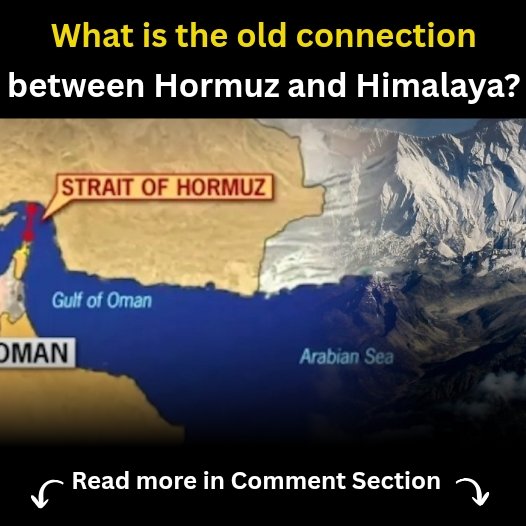
Amidst the rising tensions in the Middle East, the Strait of Hormuz has become the biggest center of discussion across the globe today. It is from here that oil and gas are supplied to a major part of the world. Because of this, the US, Iran, Gulf countries, and many major economies of the world are keeping a close eye on this narrow sea route. But do you know that the Strait of Hormuz, which is being called the world’s most important maritime lifeline today, has a story connected to a millions-of-years-old ocean that has now completely disappeared from Earth?
Yes, this is the story of the Tethys Ocean. An ancient ocean that once surrounded a vast marine area between Asia and Africa. However, over time, the movement of Earth’s tectonic plates destroyed it, and that same process gave birth to an important waterway like the Strait of Hormuz. So, what exactly was the Tethys Ocean? How did the destruction of it form the Hormuz waterway? And how did this same geological process give birth to a massive mountain range like the Himalayas? Let’s find out. Hello. I am Garima Sharma with you, and you are watching India.com’s special presentation, Bharat Facts. Today, we will tell you the story of that millions-of-years-old ocean that created the world’s most strategic maritime route.
Actually, the Strait of Hormuz, which the world considers the most crucial lifeline for energy supply today, traces its origins back to geological movements that occurred millions of years ago. To understand this story, we have to go back crores of years in time, when the structure of the Earth was not at all like it is today. At that time, two massive supercontinents existed on Earth—Laurasia in the north and Gondwana in the south. Spread between these two landmasses was a vast ocean called the Tethys Ocean. This ocean extended across large parts of today’s Central Asia, the Middle East, and South Asia. But over time, Earth’s tectonic plates slowly began to shift. Now, let’s talk about the most crucial turning point of this story. Millions of years ago, the Arabian Plate started moving northwards and collided with the Eurasian Plate. This collision began to completely change the Earth’s surface. When these plates collided with each other, the Tethys Ocean gradually started shrinking.
Large parts of the ocean disappeared, and after a process lasting millions of years, the Tethys Ocean vanished almost completely. But this very geological shift gave birth to a new structure, which was named the Strait of Hormuz. Due to the collision of the plates, the Zagros Mountain range was formed in Iran, making the sea route extremely narrow. This narrow maritime path later came to be known as the Strait of Hormuz. Today,
this waterway is counted among the world’s most important oil trade routes, through which millions of barrels of oil are shipped worldwide every day. In other words, the maritime route over which the US and Iran seem to be fighting today has its roots hidden in millions of years of geological history. But this story does not end here. In fact, this exact same process also gave birth to the world’s highest mountain range, the Himalayas. About 50 million years ago, the Indian Plate moved rapidly toward the north and collided with the Eurasian Plate. Generally, when oceanic plates collide, they sink downwards. However, both the Indian Plate and the Eurasian Plate were continental plates. Therefore, instead of sinking, they began to fold against each other and rise upward.
Over time, these uplifted rocks turned into massive mountains, and the Himalayas were gradually formed. This means that the massive mountains, sea routes, and continents visible on the Earth’s surface today are the result of tectonic plate activities that have been going on for millions of years. For now, even though the Strait of Hormuz remains the center of global politics, oil trade, and military power, its real story is connected to geological changes from millions of years ago. An ocean that once existed in a massive form on Earth has now completely vanished. Yet, its remnants have given birth to the world’s most strategic maritime route.
This story reminds us that the Earth is constantly changing, and even behind today’s geopolitics, millions-of-years-old geological processes are at work. Thus, Hormuz is not just a waterway but a living proof of Earth’s history, which took birth from the end of the Tethys Ocean and has now become the biggest center of the world’s energy politics. That’s all for today’s Bharat Facts. To know more such interesting stories related to India, keep watching India.com.