A Bond Beyond HashtagsIndia’s relationship with Italy is very old—centuries old, in fact. The connections between the two date back to the era of the Roman Empire. When the Kushans ruled the north, the Cholas and the Pandyas governed the south. These southern dynasties crossed the seven seas to conduct trade. Indian spices were highly favored in powerful empires like Rome because people paid premium prices for them.Indian black pepper was the most famous commodity, bought in massive quantities by Roman merchants. In addition, cardamom, cinnamon, pearls, ivory, silk, muslin cloth, indigo, and precious stones traveled from India to Rome. In return, Roman traders brought gold, silver, wine, glassware, corals, and luxury items to India. Even back then, Roman luxury goods were highly fashionable. This explains why archaeologists have discovered Roman gold coins in large numbers across South India.Historians believe so much gold flowed from Rome to India that in the first century, Pliny the Elder—a naval commander,
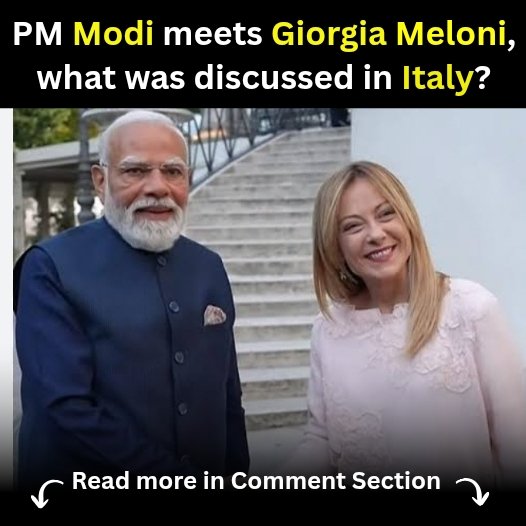
author, and friend of Roman Emperor Vespasian—complained that India was draining Rome of its wealth.### From Awkward Politics to “Melodi” MagicThere was certainly a period in between when Italian connections caused discomfort or disagreement in Indian politics, carrying a negative connotation. However, everything is fine now.Proof of this was seen during the final leg of the Prime Minister’s five-nation tour. As soon as PM Modi arrived in Italy, rivers of digital affection (a play on Italy’s Po River and India’s Ganga) began flowing across the internet. To the Prime Minister of the country famous for Ferrero Rocher, our Prime Minister gifted an indigenous ‘Melody’ candy. Giorgia Meloni was delighted by this courtesy and recorded a selfie video on her phone. Here is what she said:>
“Prime Minister Modi brought us a gift, a very, very good toffee.”> The Prime Minister then specified the name of the candy—”Melody”—followed by a moment of genuine laughter. It was easily the ‘Video of the Day.’ Otherwise, the heavy formality usually seen in meetings between heads of state distances them from ordinary people.Earlier on this same tour, when the Prime Minister visited the UAE, he met the Amir, Mohamed bin Zayed Al Nahyan. The two embraced and addressed each other as “my brother.” Now, whether calling someone “my brother” or carrying a token gift significantly impacts a visit’s actual deliverables is a separate debate. However, students of International Relations (IR) firmly place informal relationships between heads of state in the ‘desirable’ category.History is full of such examples: * **Winston Churchill and Franklin D. Roosevelt
** were close friends. Churchill visited America multiple times during World War II, even staying at the White House. * **Ronald Reagan and Margaret Thatcher** shared a rock-solid friendship. * **George W. Bush and Tony Blair’s** bond was so strong that they went to war in Iraq together.Now, many are adding the names of PM Modi and Giorgia Meloni to this list. On December 1, 2023, the two leaders met at COP28. A selfie was taken, and Meloni posted it on X (formerly Twitter) with the caption *”Good friends at COP28″* alongside the hashtag **#Melodi**. The Prime Minister quoted it, writing, *”Meeting friends is always a delight.”*Then came the G7 Summit on June 15, 2024. Meloni was hosting as Italy is a G7 member. You likely remember this meeting well—it was the one where President Biden wandered off in a different direction during a photo op, and Meloni guided him back. Another video emerged from this summit’s outreach session, where non-member delegations meet G7 representatives. A selfie video surfaced featuring PM Modi and Meloni, where she warmly smiled and said, *”Hello from the Melodi team.”*We highlight this context so you can see the method behind the madness, rather than just viewing it as a passing social media trend. Today, we break down how India-Italy relations have flourished over recent years, the agenda of this visit, and its core outcomes.### Italian Footprints in Everyday Indian LivesWe instantly recognize American cultural influence around us—Coke, Pepsi, denim jeans, McDonald’s, and iPhones. Similarly, when it comes to engineering or automobiles, we look to German brands like Volkswagen or Mercedes. But we rarely notice how deeply Italy influences our daily lives. * **Confectionery:** We mentioned Ferrero Rocher. Nutella belongs to the same company. They also make Kinder Joy—a favorite among kids for the tiny toy inside—and Tic Tac mints. * **Luxury:** For those with the budget, Italian wine, Prada, and Armani are household names. * **Defense:** It isn’t just about premium chocolates and luxury handbags. Many warships of the Indian Navy feature a main gun manufactured by *
*Oto Melara** (the Oto 76/62 Super Rapid, an autocannon capable of rapid fire). When Navy or Coast Guard ships need to fire large-caliber rounds at a target, this deck gun is used. It can fire shells in rapid succession like a rifle. India’s BHEL produces these guns under license. Oto Melara is now part of **Leonardo S.p.A.**, an Italian defense giant formerly known as *Finmeccanica* (which once owned *AgustaWestland*). * **Small Arms:** For those who carry pistols for status, owning a **Beretta** puts them on an entirely different level. Beretta tried hard to sell to Indian armed forces and police services, finding success in several pockets.### Post-1947 Geopolitics and Past FrictionFollowing World War II, Italy left fascism behind, adopted democracy, aligned with the American bloc, and joined the EU and NATO. When India became independent in 1947, it chose non-alignment. Despite this ideological difference, formal diplomatic ties between India and Italy were established almost immediately.In the 1950s and 60s, as India sought to build its industrial identity, it needed foreign companies willing to share technology for local production. This brought **Fiat** to India. India’s Premier Automobiles Limited partnered with Fiat to manufacture cars. At the time, owning a car was a massive luxury. Fiat produced a legendary vehicle: the **Premier Padmini**. With its robust build quality and heavy body, it was highly durable for Indian roads. In Mumbai, the iconic black-and-yellow taxi became synonymous with the Premier Padmini for decades.From the 1960s to the 1980s, bilateral trade expanded. India exported tea, coffee, leather, textiles, and agricultural products, while Italy exported machinery, automotive technology, equipment, and fashion goods.####
The Decades of Negative ConnotationsHowever, a negative political connotation emerged later. In 1968, Rajiv Gandhi married Sonia Gandhi, who was of Italian origin. When the Rajiv Gandhi administration signed a deal in 1986 to purchase FH77 towed artillery guns from Sweden’s **Bofors**, this Italian factor entered the discourse. When allegations of corruption surfaced, the CBI investigated, and kickback allegations were leveled against **Ottavio Quattrocchi**, an Italian businessman.Though the dust eventually settled and India opened its markets in 1991, another major controversy erupted in 2010. India signed a major deal with **AgustaWestland** (an Italian company under Finmeccanica) to buy VVIP helicopters for the President and Prime Minister. Allegations of bribery emerged, leading to the freezing of bank guarantees,
blacklisting of the firm, and the delivery being halted.Tensions peaked further in 2012 with the **Enrica Lexie case**. Two Italian marines stationed on a merchant vessel shot and killed two Indian fishermen off the coast of Kerala, mistaking them for pirates. Indian agencies arrested the marines, sparking an international dispute with Italy and the EU. The situation escalated to the point where the Supreme Court of India placed a temporary travel ban on the then-Italian Ambassador, Daniele Mancini. The marines were eventually sent back, but the incident drew heavy political criticism domestically, often laced with sharp reminders of the opposition’s Italian links.### The Modern Turnaround and Strategic GainsAs the saying goes, times change. The image of Italy in the Indian consciousness shifted significantly. In 2020, PM Modi held a virtual summit with the then-Italian PM Giuseppe Conte, putting ties back on track. Today, whenever India’s relations with Europe are discussed, Italy is at the forefront. * **Trade:** Bilateral trade hovers around $15 to $16 billion annually. In 2025, the figure stood at 14.25 billion Euros, giving India a healthy trade surplus of 2.84 billion Euros. * **Defense Collaborations:** The Adani Group has signed an MoU with the Leonardo Group to manufacture AW169M and AW109 helicopters in India.
*The Pakistan Clause:** During Italian Defense Minister Guido Crosetto’s visit to India on April 30 to meet Rajnath Singh, India placed a strict condition: any defense technology co-developed by India and Italy must not be shared with Pakistan. Italy accepted this condition. This was crucial because Pakistan has purchased drones and helicopters from Italy in recent years, and New Delhi wanted to safeguard joint intellectual property.### Highlights of the Recent VisitPM Modi arrived in Rome on the evening of May 19. He was received at the airport by Italy’s Deputy PM and Foreign Minister. * **Community Welcome:** Outside his hotel, the Indian diaspora welcomed him with dhol-nagadas and Indian flags. Italian artists performed classical dances like Kathak, Bharatanatyam, and Kuchipudi. * **Car Diplomacy:**
PM Modi and Giorgia Meloni held an extensive discussion over dinner, after which they drove through the streets of Rome in the same vehicle—an initiative dubbed “Car Diplomacy” by the media. * **The Colosseum Visit:** They visited Rome’s historic Colosseum, where Meloni showed the Prime Minister a panoramic view of the city. Meloni posted a picture on social media with the caption: *”Welcome to Rome, my friend.”* * **Official Talks:** The following morning, after receiving a ceremonial military guard of honor, PM Modi held formal talks with Meloni. He expressed India’s desire to elevate bilateral ties into a **Special Strategic Partnership**. * *
*IMEC Corridor & De-risking from China:** The leaders discussed the **India-Middle East-Europe Economic Corridor (IMEC)**. This corridor gained major momentum when Europe and Italy joined the framework during India’s G20 Presidency in 2023. Notably, Italy’s exit from China’s Belt and Road Initiative (BRI) is widely seen as a strategic realignment toward this very project.PM Modi also met the Italian President, confirming that both nations will deepen deals across trade, Artificial Intelligence (AI), and clean energy. Behind the viral selfies and AI-voiced background songs trending on social media, the India-Italy relationship has evolved into a deeply calculated, high-stakes strategic alliance.