
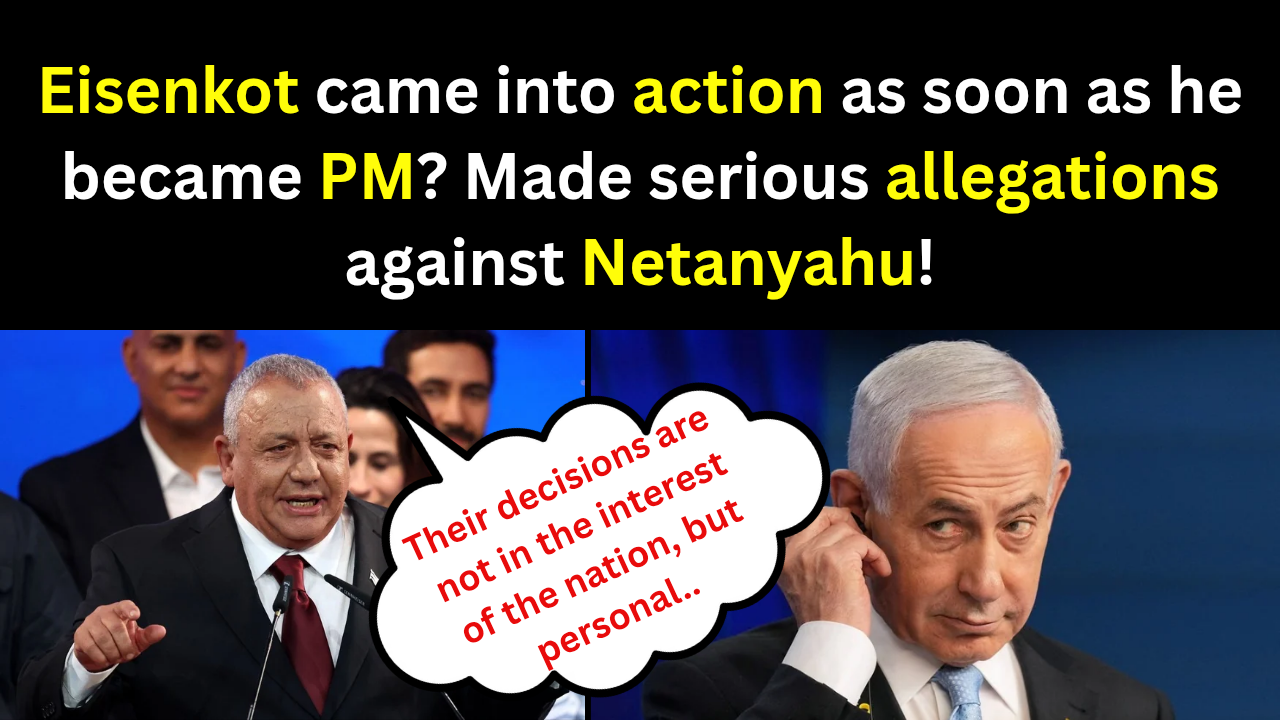
The end of Netanyahu’s rule in Israel is near. Meanwhile, the potential Prime Minister and opposition candidate, Gadi Netanyahu, has been charged by the court with several serious charges. Furthermore, he has also laid out before the world four key priorities for his rule and the new government once he becomes Prime Minister.
Amidst the fierce political tussle going on in Israel after the results of the new elections, this official statement of the Gadi Eisenhower Court has come like a new storm in the politics from Tel Aviv to Washington. Addressing the countrymen, the Gadi Eisenhower Court said that Israel is currently facing a very dangerous existential emergency and a political tsunami. The Eisenhower Court launched a scathing attack on acting Prime Minister Benjamin Netanyahu, alleging that Netanya’s rule has become a threat to the very existence of Israeli democracy. Despite being on the war front, Netanyahu is taking decisions not in the interest of the country but to fulfill his personal and political priorities.
The Gadi Eisan Court, citing data from consultation meetings with President Isa Kharzouk, decimated Netanyahu’s support base. The Eisan Court clarified that 74 Israeli parliamentarians have expressed no confidence in Netanyahu. Netanyahu now has the support of only 46 lawmakers.While a clear majority of the Knesset, more than 67 MPs, officially endorsed Eisenhower as prime minister, the court said the leader had completely lost the confidence of the public and parliament.His handling of the security forces and law enforcement agencies is extremely dangerous. The entire country is paying a heavy price for Nitesh Neho’s stubborn clinging to power. And now he has no right to hold office even for a moment. To break this political deadlock and take charge of the country, the Gandhian Organizing Court has laid out a complete roadmap for the formation of a national emergency government. The Organizing Court declared that his new government will be based on the following four main principles: Recognizing and protecting the Jewish and democratic nation of Israel as a sovereign Jewish and fully democratic state. The values of the Declaration of Independence.
The radical religious party Haredi, which was part of Netanya’s right-wing coalition, withdrew its support. Netanya, which had held onto 53 seats, now has the support of just 46 MPs. This new political equation means that Benjamin Netanya’s re-election as Prime Minister now seems unlikely. But the real drama has just begun.Opposition leader Gadi Eisancourt has the strong support of 67 MPs in Israel’s 120-seat Knesset, surpassing the 61-member majority mark. On Thursday, November 5, Israeli President Isaac Herzog held marathon meetings with representatives of all political parties at the presidential palace. During this meeting, 48 MPs from Eisancourt and 19 MPs from the two Arab parties, Joint List and Ra’am, which won a record 19 seats, officially endorsed Eisancourt to become Prime Minister. Based on the numerical strength, Gadi Eisancourt’s election as Prime Minister was considered certain. However, despite this, President Herzog has refused to nominate Eisancourt for the position. Despite the overwhelming support of 67 MPs, what has stood in the way of Eisancourt’s candidacy? There’s a significant internal conflict behind this.The three major Jewish parties in the Eisenhower coalition are reluctant to enter into a formal coalition government with the Arab parties, namely Ra’am and the Joint List. The Arab parties are offering outside support. However, the Eisenhower’s own allies are not comfortable with this arrangement.President Isaac Herzog is well aware that even if such a shaky government is formed, it will collapse within days due to internal opposition. Fearing this, President Herzog made a significant decision, stating that he would hold another round of serious discussions with all political parties before finalizing a final name,
in order to lay the foundation for a stable government in the country. The question now arises: what lies ahead in Israeli politics? Three major paths and possibilities are emerging. According to reports from Washington, US President Trump’s administration seeks to neutralize the influence of Arab parties in Israel. Top White House officials are in constant contact with Tel Aviv and are striving to form a strong national unity government by joining forces between the Eisak Court and Benjamin Nyayahu.If the Eysencourt fails to strike a balance between its Jewish allies and Arab parties during Herzok’s next talks, the president will have no choice but to dissolve parliament. If new elections are called, Netanya will be the biggest beneficiary. According to the law, Benjamin Netanyahu will remain Israel’s caretaker, or acting prime minister, until the next election is held and a new government is elected. Will the Eysencourt be able to reunite its scattered 67-member party and take the oath of office in Jerusalem, or will a new agreement be reached with Netanya at Washington’s behest? The world is watching this historic political suspense in Israel. Watch our next report.Why is this pain not going away? Yes, Israel has suffered such a shock that it is difficult to recover from it. The crushing defeat of Trump’s party in the US mid-term elections and the victory of Abdul Al Sayed of the Democratic Party has shocked even America’s closest friend Israel. Trump’s defeat has dealt a big blow to Israel. After the defeat of the Republican Party in the US mid-term elections, there is a debate in Israel about how bad this result is for them. There is a discussion in the Israeli media that in this US election, even those people have won who used to openly criticize the policies of Israel.


