But first, let us inform you that the blockade of Hormuz is still ongoing. The US Navy is deployed here, and American soldiers are continuously searching maritime vessels passing through this route. Following the attack on Iran on February 28, the Hormuz route has been virtually closed, and about 20% of the world’s oil passes through here. However, due to Hormuz being closed for the last 83 days, the supply of oil from here has nearly come to a halt. The entire world is distressed. Before the war, about 55% of India’s oil used to come through this route. But currently, about 70% of India’s oil is coming from 40 different countries across the globe. See how rapidly we have changed our strategy, and now we are not dependent on any single country for 70% of our oil; instead, we are buying oil from 40 countries around the world. And this is the very reason why you all are able to go to your workplaces using your vehicles today whenever and however you want. Meanwhile, a new oil supply route has opened up for India, and this route is Venezuela.
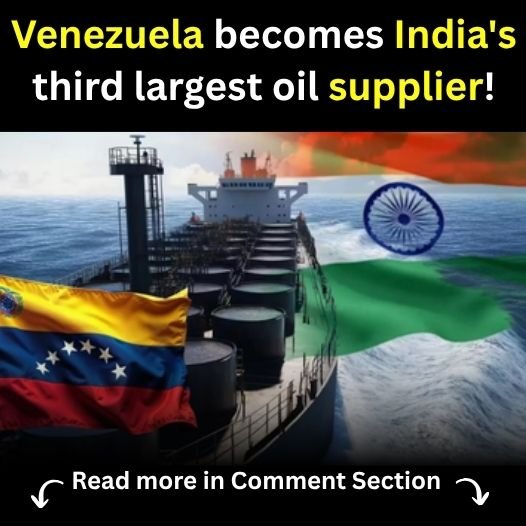
But first, take a look at these pictures of the US Navy from Hormuz, which will show you how the blockade of Hormuz is still active. While an oil crisis is currently unfolding across the world, today we are going to tell you how a new oil triangle is forming between India, the United States, and Venezuela. The biggest news for you today is that the United States has stated it is ready to provide India with as much oil as it needs. Apart from this, Venezuela has become India’s third-largest supplier of crude oil this month. Now, the US has given India the biggest offer to fulfill its oil shortage. US Secretary of State Marco Rubio is visiting India for 3 days starting May 23. But before this, he has made two major statements. First, the US is ready to give India as much oil as it needs, and second, Venezuela’s interim President Delcy Rodríguez may also visit India next week so that talks regarding oil supply can take place between India and Venezuela, and the US wants these two countries to meet and talk. Before moving forward, look at what US Secretary of State Marco Rubio said in this important statement. Opportunity President India next week then.
So, Marco Rubio is now coming to India for three days. But before reaching India, the statement he has given contains three huge geopolitical signals. First, the US fears that India might become too dependent on Russia for oil. Ever since the Ukraine war, India started buying cheap oil from Russia, and even today, India is buying most of its crude oil from Russia. But now the US wants India to buy more and more of its oil from Venezuela through the United States. Second, the US wants to bring Venezuela back into the global oil market. Venezuela possesses the world’s largest oil reserves. However, due to years of US sanctions and political crises, Venezuela could never sell this oil to the world. Consequently, Venezuela never acquired money and kept sinking into poverty. In January of this year, the US removed Venezuelan President Nicolás Maduro from power and put him in a US prison. You might remember that the US had arrested him from Venezuela, and he is currently in a US prison, and the US is now gradually taking control of Venezuela’s massive oil business as well.
And the third point is that by selling Venezuelan oil, the US now wants to make India its major energy partner, and for this reason, Marco Rubio himself is mentioning that Venezuela’s interim President may visit India next week. This month, Venezuela has also become India’s third-largest supplier of crude oil. At present, Russia ranks first in supplying crude oil to India, the UAE ranks second, and Venezuela has now moved to the third position. And Venezuela has left Saudi Arabia behind. Whereas, if we look at last month, Russia was first, Saudi Arabia was second, and the UAE was third from whom we purchased the most oil. But now Venezuela has moved to the third spot. This means that India is now buying much more crude oil from both the UAE and Venezuela compared to before, and Venezuela has now bypassed both Saudi Arabia and the US in terms of supplying oil to India. This month, Venezuela is supplying about 400,000 barrels of crude oil per day to India, which used to be 23,000 barrels until last month. This means that compared to last month,
India is now buying about 47% more oil from Venezuela, and 5.5 million barrels of oil are used daily in India. The biggest reason for this is the Iran war, after which the Hormuz route was almost closed, and this is why we are buying oil in such large quantities from Venezuela. Look at the map to see how this oil trade will take place between Venezuela and India. There are two main maritime routes between these two countries. The first route is about 15,000 km long. It takes about 25 days for any ship to cover this distance. However, this route via the Red Sea also has two choke points like the Suez Canal and Bab-el-Mandeb, which are quite risky. Now, the second route is about 22,000 km long. It is certainly a very long route, and it can take 25 to 40 days for a ship to cover it. But unlike the Hormuz route, it can never be closed. In other words, it is much safer. So these two routes are on your screen. See, I am showing you. One route is 15,000 km long, and the second route is 22,000 km long. Now, the 22,000 km one is completely safe; there is no chance of it being closed. Meaning, we can get a continuous supply from here. But its drawback is that it will take 25 to 40 days to reach India from Venezuela. And the other route is slightly shorter; it will take 25 days
. But even then, this route is somewhat complicated. On the other hand, it used to take about 2 to 3 days for any ship to reach India through the Hormuz route. So just imagine, where ships used to reach India in 2 to 3 days via Hormuz, and where it will now take 25 to 40 days. Therefore, we will get oil, our oil supply will not stop, but the oil supply will arrive very slowly. A 2 to 3-day route versus a 25-day or 25 to 40-day route, you can calculate the difference. Hence, the matter of satisfaction for you is that you will continue to get a steady supply of oil because India has found a major source in the form of Venezuela. But this oil will arrive slowly. Now let us tell you why India is buying so much oil from Venezuela. The biggest reason for this is that at present, Venezuela’s crude oil is much cheaper compared to the oil available from many other countries. Since the Iran war, crude oil prices across the world have risen from $70 per barrel to around $85 per barrel.
Though processing Venezuela’s heavy crude oil is much more difficult, some of our country’s modern refineries are capable of refining this type of crude oil easily. This means that earlier India used to depend primarily on West Asia for oil. But now, instead of relying on a single region or just a few countries, our country is adopting a strategy of buying oil from many nations so that due to any war or closure of any route, there is never a permanent impact on the supply of crude oil, and that is why, as we told you at the beginning, we are now buying our oil from 40 countries. The best part is that India has already made it clear that we will strike a deal with whichever country serves the interest of the people of India, no matter which country it is. What matters supreme to us is India’s interest. Whoever gives us cheap oil, we will buy from them, whether it is America, Russia, West Asian countries, or Venezuela.