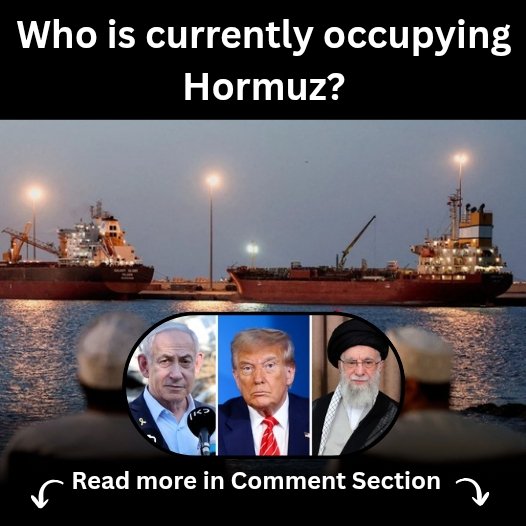
Hormuz Strait has become a flashpoint between Iran and the United States. The US military released a video showing Iran’s blockade, while Iran claims that oil tankers face no obstacles in the maritime route.
According to media reports, Iran has set up a regulatory body named the Persian Gulf Strait Authority to collect tolls. The US Central Command released a video of the blockade in the Strait of Hormuz, showing a US Marine Corps AH-1Z Viper attack helicopter hovering near the area.
The US Central Command claimed that around 90 Iranian vessels were forced to change their course during the blockade. On the other hand, the IRGC stated that 26 ships, including oil tankers and cargo vessels, passed through Hormuz in the last 24 hours. A report suggests that Iran created this new regulatory authority for passing ships, and all vessels must now seek permission from
Iran to cross Hormuz. Although Iran has not officially fixed the fee, some media reports claim that up to 17 crore rupees were charged from certain ships for a single passage.
US President Donald Trump said that opening Hormuz is necessary, but he is in no hurry as he wants to give Iran a chance to avoid heavy casualties. Iran is also constantly appealing to lift the US blockade to open Hormuz in its proposals, but the matter remains stuck on the nuclear program. Bureau report Aaj Tak Hmm.
The Strait of Hormuz is not completely occupied or owned by any single country. Instead, it is governed by international maritime law under the United Nations Convention on the Law of the Sea (UNCLOS).Geographically, the strait is bordered by **Iran** to the north and north-east, and by **Oman** (specifically the Musandam enclave) and the **United Arab Emirates** to the south.Because the strait is narrow (about 33 kilometers wide at its narrowest point), the shipping lanes used by global oil tankers and cargo vessels pass through the territorial waters of both **Iran** and **Oman**. Under international law, ships have the right of “transit passage,” meaning international vessels can pass through these territorial waters smoothly and without interference, as long as their passage remains peaceful.However, **Iran** holds significant military influence and strategic control over the northern part of the strait and frequently monitors, regulates, or challenges international shipping in the area, leading to ongoing geopolitical tensions with the United States and its allies.