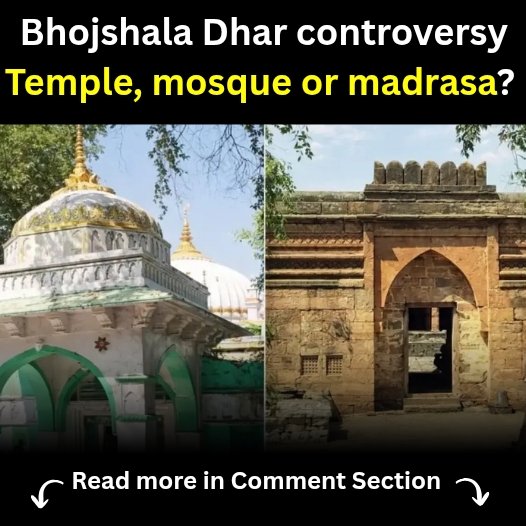
What is the dispute of Bhojshala? Why has it been reverberating for centuries? To whom does the disputed structure belong? In a landmark judgment in the state of Madhya Pradesh, where communal forces of two communities have been fighting for centuries, the High Court has ruled that the disputed historical structure at Bhojshala is a Temple dedicated to Goddess Saraswati. After hearing the writ petitions filed by the Hindu Front for Justice and others,
a bench comprising Justice Vijay Kumar Shukla and Justice Alok Awasthi said, “We have noted the continuity of the Hindu worship at the site, though regulated over time…We record finding that historical literature of the place establishes it as a centre of Sanskrit learning associated with Raja Bhoj…it indicates the existence of a temple dedicated to Goddess Saraswati at Dhar…Therefore, the religious character of the area is held to be Bhojshala with the temple of Goddess Vagdevi Saraswati.”Situated in the Dhar city of Madhya Pradesh, its name has been derived from King Bhoja of the Paramara dynasty of central India.
It is a monument of national importance, protected by the Archaeological Survey of India (ASI) under the Archaeological Sites and Remains Act, 1958. Till now, the ASI guidelines allowed Muslims to offer prayer on Fridays and Hindus to observe the festival of Saraswati Puja or the Vasant Panchami. The site is open to common visitors on other days.KK Lele, the Superintendent of State Education and head of the archaeology department in Dhar State, was the first person to report the discovery of the Sanskrit and Prakrit inscriptions at
the ‘Bhoja Shala’. Eugen Hultzsch published the Dhar inscription of Arjunavarman in Epigraphia Indica of 1905-06, and claimed that it was sent to him by Lele. However, the dispute began when Captain E Barnes reported that it was a mosque, “known among the Hindu population as ‘Raja Bhoja ka Madrassa’, or Raja Bhoja’s school.” CE Luard, in his Gazetteer of 1908, also called it Raja Bhoja’s school. However, the term Bhojshala was established by the 1930s.The controversy began because there is no mention of the Bhojshala in William Kincaid’s acclaimed book ‘Rambles among Ruins in Central India.’ Published in the Indian Antiquary in 1888, he simply mentioned the ‘Well of Wisdom’ in front of the tomb of Kamal al-Din.
He also wrote that the well was so called because a large number of Arabic books had fallen into the well many years before. As he lived in Malwa for about two decades and did not write anything about it, it is believed that there was “no living tradition about the Bhojshala in the middle decades of the nineteenth century.” John Malcolm visited Dhar and reported the collection of an inscription there. This is the Raula Vela of Roḍa, now kept in Mumbai. However, Malcolm only said that it was a “ruined mosque.” Almost two decades after Lele had identified the Bhojashala with the Kamal Maula, OC Gangoly and KN Dikshit published an inscribed sculpture in the British Museum in 1924. However, the statue in the British Museum was often misidentified as Bhoja’s Sarasvati. In the inscription of the sculpture, King Bhoja and Vagdevi, another name for Sarasvati, were mentioned. The word ‘Vagdevi’ literally means the goddess of speech, articulation, and learning.’ However, Indian scholars of the Sanskrit and Prakrit languages, notably Harivallabh Bhayani, later said that the inscription records the making of a sculpture of Ambika after the making of three Jinas and Vagdevi.
The issue has kept coming to the forefront time and again after independence. As the Muslim side claims it to be a madrasa and mosque, the tension kept on escalating from time to time. It became a source of communal friction, and occasional disturbance erupted when the religious group scheduled for the earlier time slot refused to vacate the premises in time for the next. King Bhoja or Raja Bhoja ruled parts of central India between circa 1000 and 1055. Considered as one of the greatest Hindu kings, he was also respected as a celebrated author and patron of the arts. A large number of Sanskrit books on philosophy, astronomy, grammar, medicine, yoga, architecture, and other subjects are attributed to him. King Bhoja started the construction of a Shiva temple, which would have been double the size of the temples at the Khajuraho Group of Monuments. However, he died in about 1055, and the construction came to an end, never to be resumed.