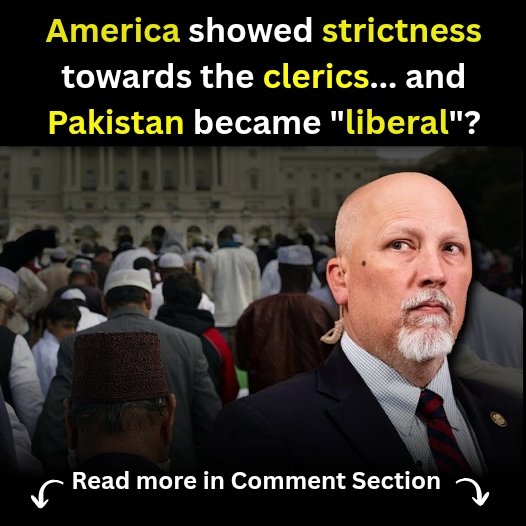
A very interesting picture is emerging in world politics at this moment. On one hand, where America is preparing to block the entry of foreign religious leaders in the name of national security, on the other hand, Pakistan appears to be engaged in an effort to showcase its image as more progressive and liberal than before. In America, Republican Representative Chip Roy has introduced a bill named the IMAM Act, aimed at preventing foreign religious leaders accused of spreading extremist ideology from entering America. However, during this same time, a picture emerged from Pakistan that has surprised the entire world.
After 79 years, historical pre-partition Hindu, Sikh, and British era names are being restored in Lahore. Old names like Krishan Nagar, Laxmi Chowk, Dharampura, and Queens Road are now returning. That is to say, while America is showing strictness against extremism on one side, Pakistan, on the other side, is trying to project itself as a soft country that preserves culture and heritage. So, does Pakistan want to change its global image? Is this just cultural preservation, or a major political message being sent to the world? Let’s find out. Hello, I am Garima Sharma with you and you are watching India.com. Today, we will tell you about America’s IMAM Act and Pakistan’s changing liberal image, which has sparked a new debate in international politics.
In fact, over the last few years, the debate has been constantly intensifying in America regarding whether foreign religious leaders are using religious visas to try and spread extremist ideology. Republican leaders allege that certain religious preachers reach America and promote a mindset that is considered against American security and Western values. Amidst this debate, Republican Representative Chip Roy from Texas introduced the IMAM Act in the American Congress. IMAM stands for ‘Inhabiting Militant Adversarial Mullahs Act’. This bill proposes an amendment to American immigration law, under which foreign nationals holding religious positions such as Imams, Grand Imams, Muftis, Ayatollahs, and others can be barred from coming to America on religious visas. Chip Roy states that America should not roll out the red carpet for people who spread anti-American ideology or support extremist regimes.
This means America now appears to be preparing to make its religious entry system even stricter in the name of security. However, controversy has also started over this bill. Critics argue that it will send a message specifically targeting religious leaders of the Muslim community.But during this same time, news from Pakistan has made the entire picture even more interesting. 79 years after the formation of Pakistan, the government of Punjab Chief Minister Maryam Nawaz has decided to restore the old names of several historical streets and areas in Lahore. This means places whose names were changed after the partition are now being given their old Hindu, Sikh, and British era names again. Islamapura is becoming Krishan Nagar once more. Maulana Zafar Ali Khan Chowk will now be called Laxmi Chowk. Mustafabad is being renamed Dharampura again, and Fatima Jinnah Road has once more become Queens Road. This entire campaign is being run under the Lahore Authority for Heritage Revival, i.e., the LAHR project, which is being overseen by former Prime Minister Nawaz Sharif. Not only this, there are also plans to
restore old cricket grounds and traditional wrestling arenas (akhaadas) in Lahore’s historic Minto Park. This is the very place where Indian cricketer Lala Amarnath once used to go for practice and where legendary figures like Gama Pehlwan used to compete.In such a scenario, the question arises whether Pakistan wants to break out of its extremist image and present a cultural and progressive face to the world that everyone appreciates. Because at the exact time America is sending a strict message against extremism, Pakistan is bringing forward its heritage, multicultural history, and old Hindu-Sikh names. Many political analysts view this as Pakistan’s image-makeover strategy, aiming to send a message to the world that Pakistan is not just a country with a religious identity, but also a society with
a shared historical heritage. Currently, two completely different pictures are visible to the world. On one side is America, which is preparing to increase strictness on religious entry in the name of national security. On the other side is Pakistan, which appears busy building a liberal image by reviving its historical and cultural identity. Now it will be interesting to see whether Pakistan’s new strategy remains limited only to image building or actually becomes the beginning of social and political change there. Meanwhile, the debate over the IMAM Act in America could intensify further, as the question is not just about security, but also about religious freedom and identity politics. For now, these two different strategies of both countries are presenting a new picture of changing world politics, where security and image have both become major weapons of global diplomacy. That’s all for now in this report. Stay tuned to India.com.